
How to Measure Yourself for a Corset: The Complete UK Sizing Guide
Eimee Team on 6th Aug 2026
We've hand-made and fitted corsets in our UK workshop for years, and if there's one thing we've learned, it's this: a corset that fits comes down to a few accurate measurements taken before you order. Get them right and your corset will cinch beautifully, feel supportive and last for years. Get them wrong and this is where most first-time buyers slip up and it will gape, pinch or simply refuse to close. This guide shares exactly how we measure our own customers: every measurement you need, how much smaller a corset should be than your waist, how to read a UK size chart, and the little mistakes we see again and again — so you can order with complete confidence.
What size corset do I need?
Corset sizing is different from dress sizing, and that catches a lot of people out. A corset is sold by its closed waist measurement the size of the waist when the corset is fully laced shut. Because a corset is designed to reduce your waist, that number is deliberately smaller than your body.
The standard rule across UK and international corsetières is simple: take your natural waist measurement and subtract 4 inches (10 cm). That 4-inch gap gives a comfortable, effective cinch for most people while still leaving room to loosen or tighten the laces. If your natural waist measures 28", you order a 24" corset; if it measures 34", you order a 30", and so on. Corsets are almost always made in even-numbered sizes (18, 20, 22, 24… up to 40 and beyond), so you round to the nearest even size.
That said, the waist number alone will not guarantee a good fit. Two people with an identical 28" waist can need completely different corsets if one has a long torso and full hips and the other is short-waisted with a straight figure. That is why the measurements below matter.
Before you start: what you'll need
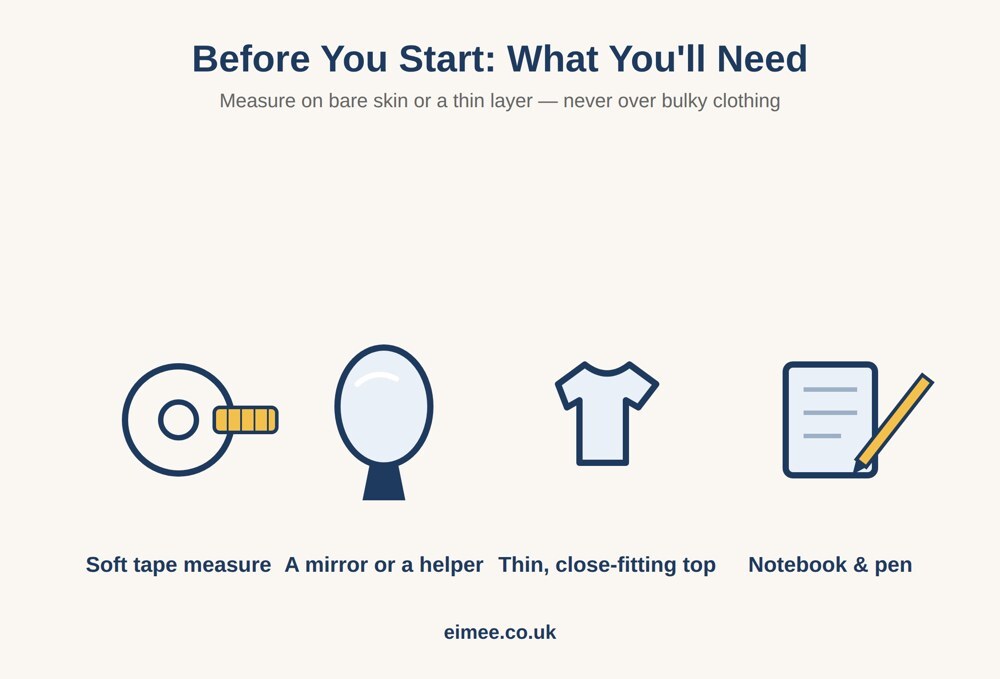
- A soft fabric tape measure (the kind used for sewing, not a metal builder's tape).
- A mirror, or a friend to help some measurements are far easier with a second pair of hands.
- Thin, close-fitting clothing or bare skin. Never measure over a jumper, a padded bra or bulky fabric.
- A notebook to write everything down in both inches and centimetres, so you can match any size chart.
Stand up straight, relax your stomach and breathe normally throughout. Holding your breath or sucking in will give you a false reading and a corset that is too small.
The measurements that matter
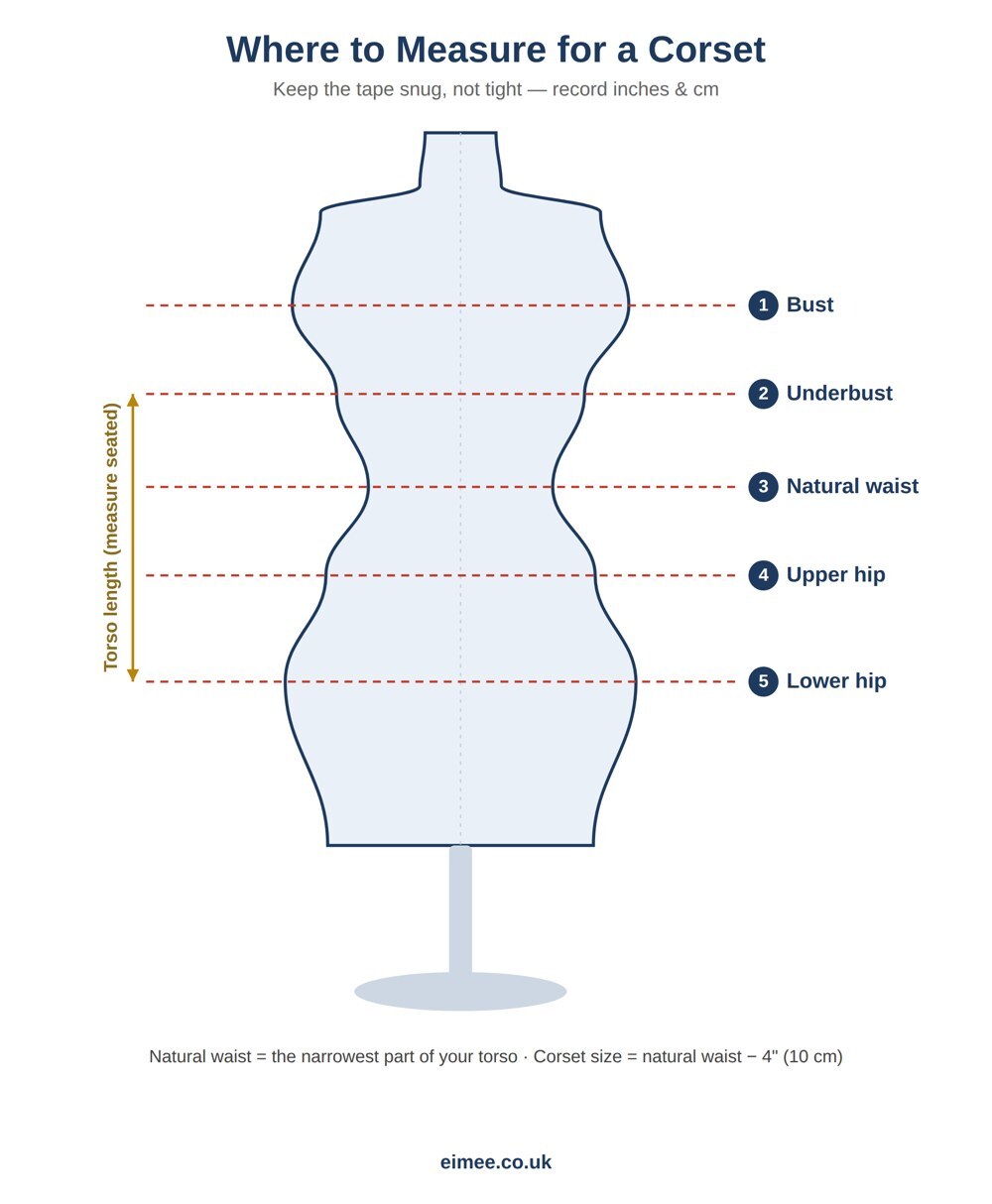
There are five measurements that describe how a corset will sit on your body. For a simple underbust corset you mainly need your natural waist; for a longer or overbust style, all five become important.
1. Natural waist (the most important measurement)
Your natural waist is the narrowest part of your torso, usually about 2.5 cm (an inch) above your belly button and roughly level with your elbows when your arms hang loose. An easy way to find it is to bend gently to one side the crease that forms is your natural waist. Wrap the tape around this point, keep it level all the way round, and take the reading with the tape snug against your skin but not compressing it.
2. Underbust
Measure directly underneath your bust, where the band of a bra sits, right around the ribcage. This measurement decides where the top edge of an underbust corset will rest and how it supports you. For men, this is measured around the chest just below the pectoral muscles.
3. Bust / overbust
Measure around the fullest part of your bust, keeping the tape level across your back. You only need this for an overbust corset (one that covers the bust). It ensures the corset supports and shapes the bust rather than gaping or squashing.
4. Upper hip and lower hip (your hip spring)
Corsets don't just shape the waist they curve over the hips too. Measure your upper hip (around the top of the hip bones, roughly 5 cm below the natural waist) and your lower hip / full hip (around the widest part of your bottom). The difference between your waist and your hips is called your hip spring. A large hip spring means you need a corset with generous hip room, or it will dig in at the bottom edge.
5. Torso length
This is the measurement most beginners skip and the one that ruins the most orders. Sit down straight on a hard chair and measure from your underbust down to the surface of the chair (your lap). This tells you how tall a corset your body can physically take. A corset that is too long for your torso will dig painfully into your hips or thighs when you sit; one that is too short won't give the smooth line you want. If you have a short torso, look for a waspie (a short corset that focuses on the waist); if you're long in the body, a longline style will suit you.
How to take each measurement, step by step
- Step 1 — Wear thin clothing or nothing on top. Bulk adds false inches.
- Step 2 — Find your natural waist by bending to the side, and mark it mentally.
- Step 3 — Wrap the tape level. Check in a mirror that the tape isn't riding up at the back — a tilted tape gives a wrong number.
- Step 4 — Snug, not tight. You should be able to slip one finger under the tape. Don't pull it into the skin.
- Step 5 — Breathe normally and take the reading on a relaxed out-breath. Never suck in.
- Step 6 — Measure twice. Write down each figure and repeat it once to be sure. Record both inches and centimetres.
How much smaller should a corset be? Understanding waist reduction
A corset works by gently compressing your waist inwards this is called waist reduction. The 4-inch (10 cm) reduction is the standard starting point because it delivers a noticeable hourglass shape while staying comfortable for everyday wear.
- Beginners: stick to a 4-inch reduction. It's flattering, comfortable and easy to wear for a few hours.
- Experienced wearers & tightlacers: some go to 5–6 inches or more, but only after their body and corset have adjusted over time.
- Soft or squishy midsection: you may comfortably take a slightly larger reduction. A firmer, more muscular midsection reduces less.
Never chase a dramatic reduction on day one. A corset should feel like a firm, supportive hug — never sharp pain, pins and needles or breathlessness. If it hurts, loosen the laces.
Corset size vs dress size vs waist size
These three numbers are not the same, and mixing them up is the most common ordering mistake:
- Dress size (UK 8, 10, 12…) is a general clothing size and tells you very little about your exact waist. Never order a corset by your dress size.
- Waist size is your actual body measurement for example 30".
- Corset size is the closed waist of the corset usually your waist minus 4 inches, e.g. 26".
Always order by your measured natural waist, then apply the 4-inch rule, and always check the specific size chart of the corset you're buying, because cut and hip spring vary between styles.
The modesty gap: why a fitted corset shouldn't fully close
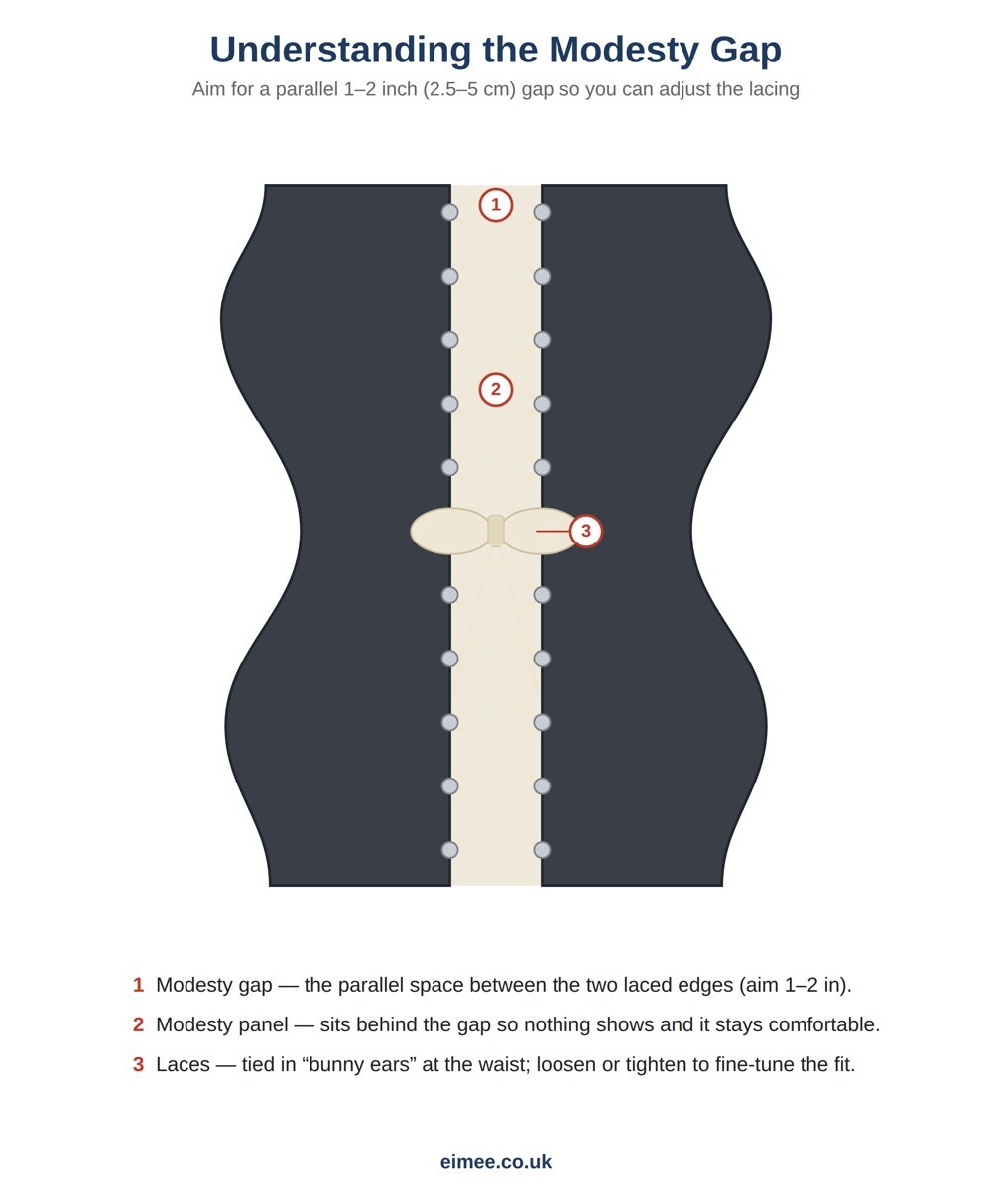
When you lace a corset, you should aim for a parallel gap of about 2.5–5 cm (1–2 inches) down the back, between the two edges of the lacing. This is the modesty gap, and a modesty panel sits behind it to keep everything smooth and comfortable. That gap is deliberate and desirable it gives you room to lace tighter as your body seasons to the corset, or to loosen off after a meal. A corset laced completely shut with the edges touching offers no room to adjust and usually means the corset is slightly too big for you.
Underbust vs overbust: which measurements you need
The style of corset changes which measurements matter most:
- Underbust corset (stops below the bust): you mainly need your natural waist, plus underbust, hips and torso length for the right height and curve. These are the easiest to fit and the best choice for beginners.
- Overbust corset (covers the bust): you need everything above plus your bust measurement, because the corset has to shape and support the bust as well as the waist.
If you're not sure which to choose, our range of underbust and overbust leather corsets shows the difference clearly.
Fitting to your body shape: hip spring and torso length
Most fit problems come down to hips and torso length rather than the waist:
- Big hip spring (curvy): choose a corset cut with a generous hip, or the bottom edge will bite into your hips. A hip gore or panelled hip helps here.
- Straight figure (small hip spring): a heavily hip-sprung corset may gape at the hips — a straighter cut suits you better.
- Short torso: a waspie or short underbust avoids digging into your lap when seated.
- Long torso: a longline style gives a smoother, more elongated line.
If your measurements fall between sizes, or your hip spring and torso length don't match a standard chart, that's exactly when made-to-measure comes into its own more on that below.
Measuring for a men's corset
Men's corsets are sized the same way, using the natural waist minus roughly 4 inches rule, but the shape is cut straighter with less hip spring and more room through the ribcage. Men should measure the natural waist (often at or just above the navel), the chest just below the pecs for an underbust fit, and torso length when seated. If you're buying for posture support or waist training, start with a modest reduction and build up gradually. You can see our full range of men's leather corsets for fit examples.
UK corset size chart
Use this as a starting guide. Find your natural waist, and the corset size column shows the typical size to order (a 4-inch reduction). Always confirm against the exact chart for the corset you choose.
| Your natural waist (inches) | Your natural waist (cm) | Corset size to order |
|---|---|---|
| 24" | 61 cm | 20" |
| 26" | 66 cm | 22" |
| 28" | 71 cm | 24" |
| 30" | 76 cm | 26" |
| 32" | 81 cm | 28" |
| 34" | 86 cm | 30" |
| 36" | 91 cm | 32" |
| 38" | 97 cm | 34" |
| 40" | 102 cm | 36" |
| 42" | 107 cm | 38" |
| 44" | 112 cm | 40" |
If you fall between two sizes, size up rather than down you can always lace a slightly larger corset tighter, but you can't make a too-small corset bigger.
How a well-fitted corset should feel
A properly sized, steel-boned corset should feel firm, supportive and secure like a strong hug around your middle that holds you upright. When new, it will feel stiff. That's normal: corsets need “seasoning”, a gentle breaking-in over the first few wears where you lace loosely for short periods so the boning and fabric mould to your shape. You should never feel sharp pinching, numbness, difficulty breathing or pain. If you do, loosen the laces the fit or the reduction is too aggressive. Take a look at our steel-boned leather corsets to see the styles this applies to.
Common measuring mistakes to avoid
- Measuring over clothes. Even a thin top can add an inch. Measure on bare skin or the thinnest layer.
- Sucking in. Always measure on a relaxed breath, or your corset will arrive too small.
- Measuring the wrong spot. The natural waist is the narrowest point, not where your jeans sit.
- Pulling the tape too tight. Snug, with a finger's space not compressed.
- Forgetting torso length. The right waist size in the wrong length still won't fit. Always measure seated.
- Ordering by dress size. Always order by your measured waist, then apply the 4-inch rule.
When to choose a made-to-measure corset
Standard sizes suit most people, but choose made-to-measure if your measurements fall between sizes, your hip spring is very high or low, your torso is unusually long or short, or you simply want a corset built precisely to your body. At Eimee we hand-make leather and steel-boned corsets in the United Kingdom, and our personal tailoring service builds your corset to the exact measurements from this guide so you get a true, comfortable fit rather than a compromise. Because we make each piece ourselves, we can adjust waist reduction, hip room and length to suit you.
Frequently asked questions
What size corset do I need?
Measure your natural waist (the narrowest part of your torso) and subtract about 4 inches (10 cm). That figure, rounded to the nearest even number, is your corset size. For example, a 30" natural waist usually takes a size 26" corset.
How do I measure my waist for a corset?
Use a soft tape measure around the narrowest part of your torso roughly an inch above your belly button. Keep the tape level and snug but not tight, breathe normally, and take the reading on a relaxed breath. Record it in both inches and centimetres.
How much smaller should a corset be than my waist?
About 4 inches (10 cm) smaller is the standard, comfortable reduction for most people, especially beginners. Experienced wearers may go further over time, but 4 inches gives a flattering shape without discomfort.
Is corset size the same as my dress size?
No. Never order a corset by your dress size. A corset is sold by its closed waist measurement, which is based on your actual measured waist minus around 4 inches not on UK dress sizing.
What if I'm between two corset sizes?
Size up rather than down. You can lace a slightly larger corset tighter to get the fit you want, but you cannot make a corset that's too small any bigger. If you're consistently between sizes, made-to-measure is the ideal solution.
How tight should a corset be?
A well-fitted corset feels firm and supportive, like a strong hug, with a parallel 1–2 inch gap at the back for adjustment. It should never cause sharp pain, numbness or breathlessness. If it does, loosen the laces.