
How to Put On a Corset (and Lace It Properly): Step-by-Step
Eimee Team on 6th Aug 2026
Putting on a corset for the first time can feel daunting all those laces, a stiff busk down the front, and a nagging worry that you'll lace it wrong or pull it too tight. We fit and lace corsets in our UK workshop every week, and the truth is it's far simpler than it looks once you know the order to do things in. Rush it, though, and you'll get gaping at the top, a lace tangle at the back, or that uncomfortable pinch that puts people off corsets for good. This guide walks you through exactly how we put a corset on a customer: loosening the laces first, fastening the busk, tightening evenly from top and bottom towards the waist, tying it off neatly with bunny ears, and how to break the corset in so it moulds to your body. Follow it in order and your very first lace-up will sit smooth, feel supportive and look the way it should.
How to put on a corset (quick steps)
Here is the whole process at a glance. Each step is explained in full further down, but if you've done this before, this checklist is all you need:
- Loosen the laces fully at the back so the corset opens wide.
- Wrap it around your waist and line up the front busk.
- Fasten the busk, connecting each loop over its matching stud.
- Settle it in place — level at the waist, sitting where it's comfortable.
- Take up the slack in the laces, working from the top down and the bottom up.
- Pull the two waist loops (bunny ears) to cinch the waist.
- Even out the gap so it's parallel top to bottom.
- Tie off in a bow at the waist and tuck the ends away.
The single most important idea to remember: you tighten a corset towards the waist from both directions, never all in one go from one end. That's what gives a smooth line and stops the laces jamming.
Before you start — loosen the laces
This is the step first-timers most often skip, and skipping it is why a corset feels impossible to get into. A corset arrives laced up fairly snug for display. Before you try to wear it, turn it over and loosen the laces generously run your fingers down the two lengths of lacing at the back and pull the crossed sections outward until the whole thing opens up with several inches of gap. You want it loose enough to fasten the front busk without any strain.
If you try to do up the busk while the laces are still tight, you'll fight the corset the entire time and risk bending a busk stud. Loose laces first, every time. It takes ten seconds and makes everything that follows easy.
A quick word on the parts, so the rest of this guide makes sense. The stiff panel down the front with the metal studs and loops is the busk that's your opening and fastening. The laces run down the back in a criss-cross. Behind those laces sits a strip of fabric called the modesty panel (or modesty placket), which stops your skin or clothing showing through the laced gap. Knowing front-from-back before you start saves a lot of confusion.
Fastening the busk
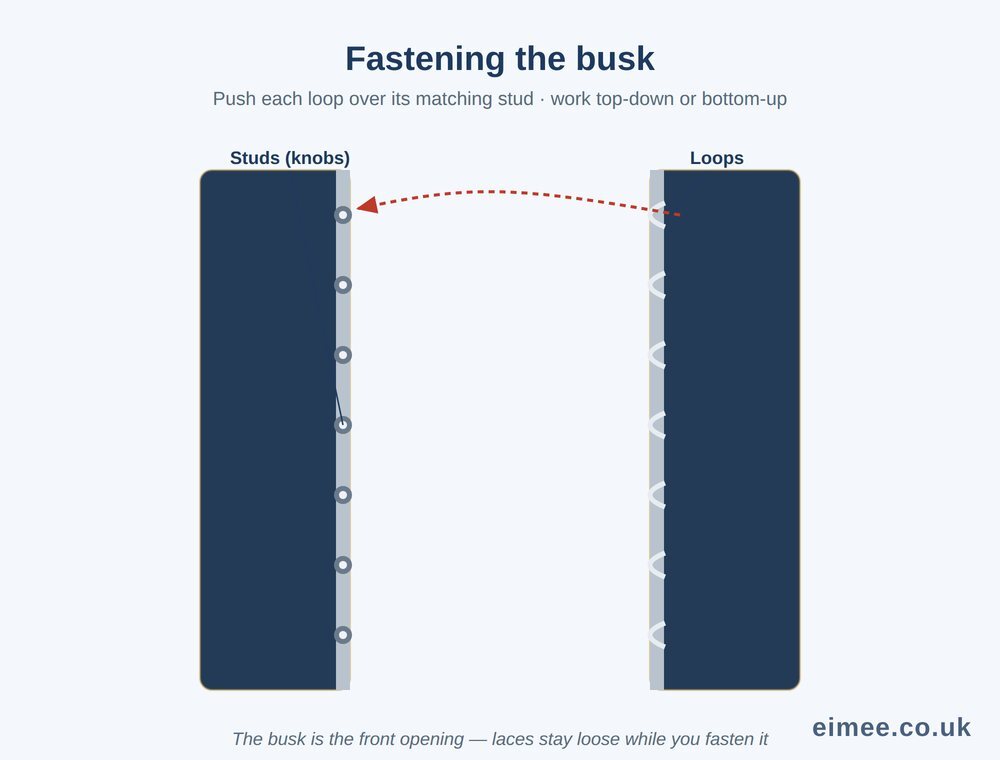
The busk is the two-part steel fastening down the front of most corsets: one side has small round studs (knobs), the other has loops. Here's how to do it up smoothly:
- Hold the corset in place around your body, roughly level, with the busk at the centre front.
- Start from the top or the bottom most people find it easiest to hook the top loop first, then the bottom, then fill in the middle. Some prefer bottom-up; both work, so use whichever your hands find easier.
- Push each loop over its stud by pressing the two sides of the busk slightly together and guiding the loop across. If a loop won't reach, your laces are still too tight loosen them more.
- Check every loop is seated once you're done. A half-fastened busk can pop open under tension.
If the busk feels like a real struggle even with loose laces, it usually means the corset is a size too small at the waist, or you're holding your breath. Relax your stomach, breathe out gently and try again. For how corset sizing works and how to be sure of your size before you ever get to this stage, see our complete UK corset sizing guide.
Tightening from top and bottom to the waist
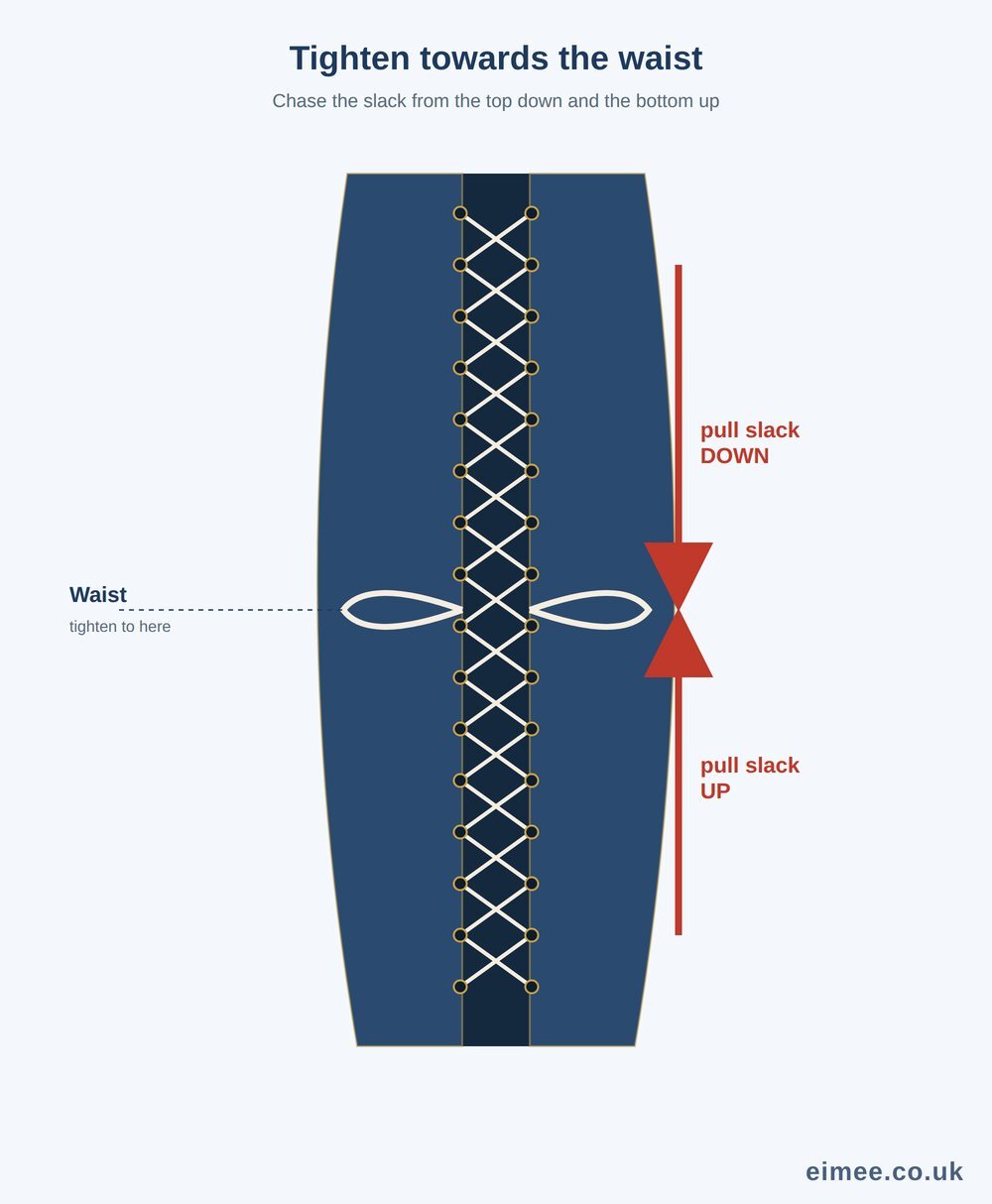
With the busk done up, the corset is on but it's still loose. Now you tighten the back laces. This is where technique matters most, and where the “pull towards the waist from both ends” rule comes in.
Reach behind you and find the laces. Starting at the top, use your fingers to chase the slack downward pull each crossed section of lace outward a little, moving down towards the waist, so the excess lace gathers at the middle. Then do the same from the bottom, chasing the slack upward towards the waist. You're funnelling all the loose lace into the two big loops that sit at your waistline.
Work in stages and keep it even. Don't yank one side tight and then the other alternate, a little at a time, so the corset closes evenly and the back stays parallel. If you rush and pull hard from the top only, you'll get a corset that's tight at the ribs and gaping at the hips, which is uncomfortable and unflattering.
The right order, in short
- Loosen the whole lacing first.
- Chase slack down from the top to the waist.
- Chase slack up from the bottom to the waist.
- Pull the waist loops to set your reduction.
- Re-even the gap top and bottom.
Tying off (bunny ears) and the modesty gap
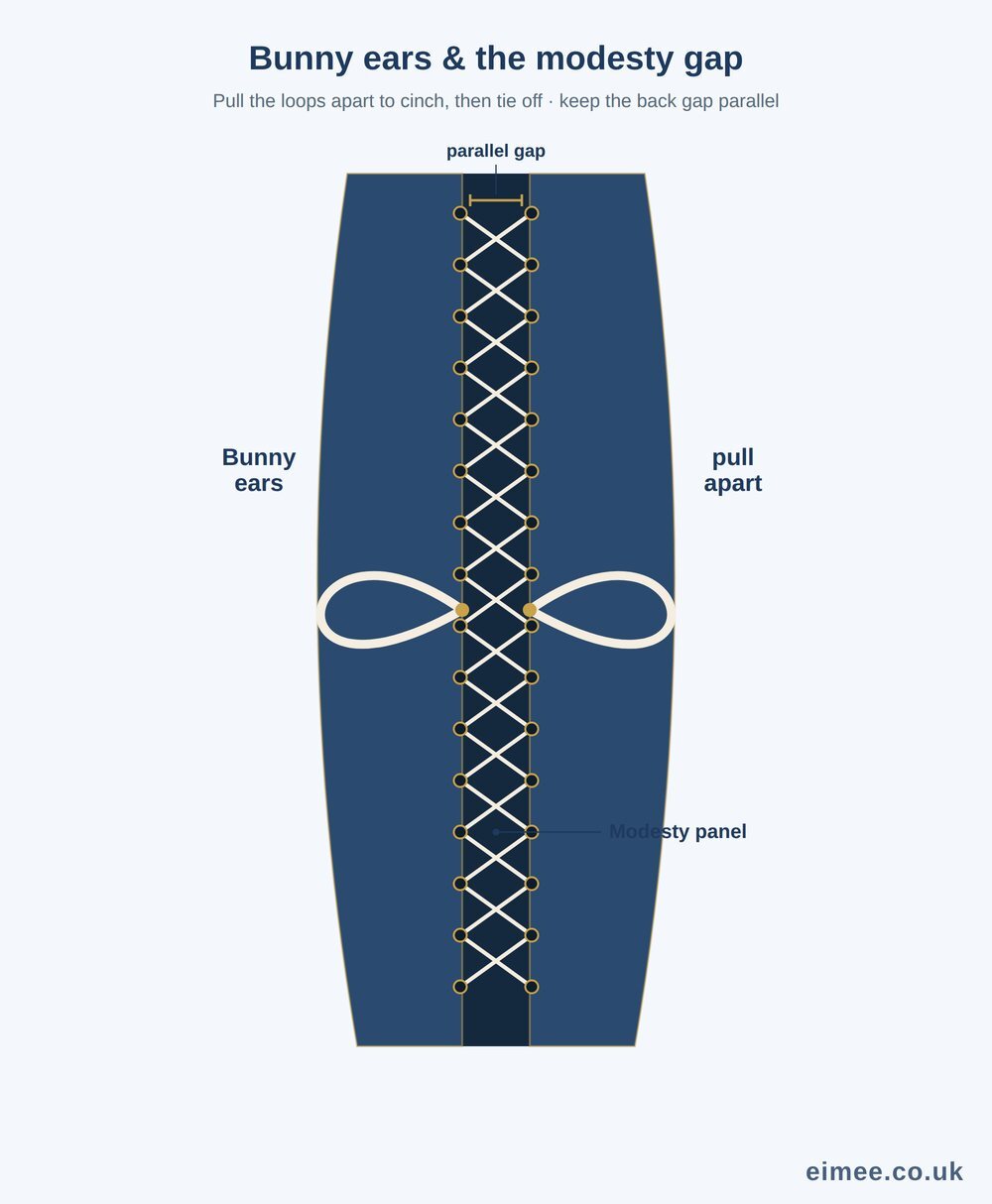
Those two large loops of lace that gather at your waist are affectionately called the bunny ears. They're your tightening handles and the key to lacing a corset by feel.
To cinch in, simply pull the two bunny ears apart, outward and away from each other, drawing the waistline of the corset closed to the tightness you want. Pull evenly on both so the reduction is symmetrical. When it feels supportive but comfortable, tie the bunny ears in a firm double bow at the waist, just as you'd tie a shoelace, and tuck the trailing ends inside the corset or under a waistband so they don't dangle.
Now look at the gap at the back. On a well-fitted corset the two back edges should not meet they sit apart with a straight, even channel between them, and the modesty panel shows through that channel to cover your skin. This is the lacing gap (or modesty gap), and it's meant to be there. Aim for a parallel gap the same width top to bottom, usually around 2–5 cm. A parallel gap means the corset fits you correctly and still has room to be tightened further as you break it in.
What you don't want is a gap shaped like a V (edges touching at the top, wide at the bottom) or a ) ( shape bowing in the middle. A V-gap usually means the corset is too big at the waist or too small at the hips; a wide bottom often means it's the wrong shape for your hip spring. If your gap won't sit parallel no matter how you lace, the corset shape doesn't match your body a good reason to consider a made-to-measure corset cut to your figure.
How tight should it be?
This is the question we're asked more than any other, and the honest answer is: firm, supportive, and comfortable not painful. A corset should feel like a strong, steady hug around your middle. You should be able to breathe (from your chest, a little higher than usual), talk and sit down.
Signs you've got it right: your waist feels held and your posture straightens naturally; there's a parallel gap at the back; you can slide a flat hand between your chest and the top edge. Signs you've gone too far: sharp pain, pinching, numbness, tingling, breathlessness, or feeling faint. If you feel any of those, loosen the laces immediately a corset should never hurt.
For your first few wears, aim for a gentle reduction of around 2 inches (5 cm), well short of the corset's full closure, and only tighten further once your body and the corset have got used to each other. There's no prize for lacing tight on day one, and doing so is the fastest way to a bad first experience. If you're new to how much a corset should reduce your waist in the first place, our sizing guide explains waist reduction in detail.
Putting on a corset by yourself
Yes you can absolutely lace a corset on your own, and most people do it solo every day. The trick is that you tighten it from the front of your body, not by reaching awkwardly behind your back.
- Loosen the laces fully while the corset is off.
- Put it on back to front if you like fasten the busk at your front, then rotate the corset around your body so the busk ends up at the front and the laces at the back. (Many people fasten the busk while the corset is turned to the front, then spin it round.)
- Reach behind, find the bunny ears, and pull them forward around your sides to the front where you have leverage and can see what you're doing.
- Take up the slack top and bottom as described above, working in small stages.
- Bring the bunny ears round to your back and tie off.
A helpful one-off trick when a corset is brand new and stiff: loop the bunny ears over a door handle, then gently lean your weight away to draw the laces snug evenly, before tying off. Only do this gently. With a little practice, most people lace themselves in under a minute.
Having a friend help is genuinely easier for your very first time, because a second pair of hands can chase the slack and keep the gap parallel while you relax and breathe. If someone is lacing you, ask them to pull gradually and evenly, and to stop the instant you say so.
Seasoning a new corset (breaking it in)
A quality steel-boned corset is a structured garment, and like a good pair of leather shoes it needs breaking in. This process is called seasoning, and it lets the corset mould to the unique shape of your body while the fabric and bones settle. Skipping it can stress the seams and shorten the corset's life, so it's worth the patience.
- Wear it loosely first. For the first few sessions, lace to only a gentle snugness — nowhere near full closure.
- Keep sessions short. Start with an hour or two at a time for the first week or so.
- Warm it with body heat. Wearing the corset gently warms the fabric and coutil, helping it curve to you. This is why seasoning can't be rushed.
- Increase gradually. Over one to two weeks, slowly build up both the time you wear it and how far you lace it in.
Always wear a thin liner or close-fitting top under the corset while seasoning (and ideally always). It protects the corset from sweat and body oils and keeps it fresh between the rare occasions it needs cleaning.
Taking a corset off safely
Coming out of a corset is the reverse of putting it on, and just as worth doing properly:
- Untie the bunny ears at the waist.
- Loosen the laces gradually, working the slack back up and down the lacing so the corset opens evenly don't just wrench it apart.
- Unfasten the busk from the bottom up (or top down), supporting the front so the studs don't strain.
- Sit still for a moment. After a longer wear, take a minute before rushing off your body readjusts.
- Hang or lay it flat. Store the corset laid flat or rolled, never scrunched, so the bones stay straight.
Leaving the laces reasonably loosened after you take it off also means it's ready to slip into easily next time.
Frequently asked questions
How do you put on a corset for the first time?
Fully loosen the back laces so the corset opens wide, wrap it around your waist and fasten the front busk. Then take up the slack in the laces, working from the top and bottom towards the waist, and pull the two waist loops (bunny ears) to a gentle, comfortable snugness — not fully closed. Aim for a parallel gap at the back and tie off in a bow. For your first wear, keep it loose and short.
How tight should a corset be?
Firm and supportive, like a strong hug — never painful. You should be able to breathe, talk and sit comfortably, with a straight, parallel gap of about 2–5 cm at the back. Sharp pain, pinching, numbness or breathlessness all mean it's too tight; loosen the laces straight away. For a first wear, a gentle 2-inch (5 cm) reduction is plenty.
Can you put on a corset by yourself?
Yes. Loosen the laces fully, fasten the busk at the front, then bring the waist loops (bunny ears) round to the front where you have leverage, take up the slack top and bottom, and bring the laces back to tie off. Looping the bunny ears over a door handle and leaning gently away helps with a stiff new corset. Most people lace themselves solo in under a minute with practice.
What are bunny ears in corset lacing?
Bunny ears are the two large loops of lace that gather at the waist once you've chased the slack in from the top and bottom. They're your tightening handles: pull them apart to cinch the waist, then tie them in a bow to secure the corset. They make it possible to lace and adjust a corset by feel, even by yourself.
How do you break in (season) a new corset?
Seasoning means wearing a new corset loosely for short sessions — an hour or two at a time — for the first week or two, letting your body heat help it mould to your shape before you lace it tighter. Never lace a brand-new corset fully closed on day one. Wear a thin liner underneath and build up time and tightness gradually. Proper seasoning makes the corset more comfortable and helps it last for years.